
A gentle, considered approach to lifelong health
Chiropractic care is a regulated health profession concerned with the function of the spine, nervous system, and musculoskeletal system, and with how these systems support the well-being of the whole person. At Dynamic Neuro, we draw on nearly forty years of clinical experience to provide chiropractic care that is thoughtful, evidence-informed, and tailored to each individual who walks through our doors, from the youngest baby to the oldest grandparent.
Our name reflects our particular interest: the dynamic processes of growth, development, and adaptation that unfold over a lifetime. Whether you are seeking support for yourself, your child, or your whole family, we are here to help.
What is Chiropractic?
The World Health Organisation defines chiropractic as "a health care profession concerned with the diagnosis, treatment and prevention of disorders of the neuromusculoskeletal system and the effects of these disorders on general health".
In Australia, chiropractors complete a minimum of five years of university education and are registered nationally with the Australian Health Practitioner Regulation Agency (AHPRA) through the Chiropractic Board of Australia. Our training focuses on the structure and function of the spine, the nervous system, and how the body adapts to the chemical, physical, and emotional stressors of daily life.
Chiropractic care uses a range of manual techniques, including gentle adjustments, soft tissue work, cranial techniques, and specific low-force methods, to support healthy joint motion, nervous system regulation, and whole-body function. The goal is not simply symptom relief but helping the body work well on its own terms.
Nervous system regulation
The nervous system is the body's communication network, coordinating movement, sensation, digestion, breathing, sleep, and our responses to stress. Because the spine and cranial system house the central nervous system, chiropractic care has long been interested in how spinal and nervous system function influence one another. Gentle chiropractic techniques aim to support healthy joint motion and musculoskeletal function in ways that may help the body feel more comfortable and resilient through the demands of daily life.


Performance and function
Healthy movement is foundational to wellbeing, whether that means a baby progressing through tummy time, a child running freely in the playground, an athlete returning to training after injury, or an older adult moving with confidence in everyday life. Chiropractic care supports the body's capacity to move, adapt, and perform by attending to spinal and joint function, postural alignment, and the coordination between the nervous and musculoskeletal systems. The aim is not peak output for its own sake, but the kind of comfortable, capable function that allows people of every age to do what matters to them.
Developmental Milestones
Development is a remarkable, ongoing process, most visible in the first years of life but continuing through childhood, adolescence, and into adulthood. Each stage builds on the foundations laid before it, and healthy movement, posture, and musculoskeletal function play an important role at every step. Chiropractic care can support comfort, mobility, and musculoskeletal function as children move through the physical demands of each stage, from head control, rolling, crawling, and walking, through to the postural and learning demands of school. For adolescents and adults, the same principles apply to the ongoing demands of growth, work, and life. The body's developmental capacity does not end in childhood, and neither does our care.


Babies and children
Infancy and childhood are times of remarkable change. Babies grow more in their first year than at any other point in life, and the connections between brain and body are being laid down at an extraordinary pace. The early years bring a series of developmental milestones, from feeding and sleeping in the early weeks, through rolling, crawling, and walking, to the postural demands of school age.
Parents come to us for a range of reasons, seeking chiropractic care for their babies and children. These can include:
- Feeding, latching, or settling difficulties in infancy
- Asymmetries in head shape, neck movement, or preference for one side
- Support through the physical demands of crawling, walking, and early milestones
- Postural concerns as children grow and spend longer hours at desks and devices
- General developmental wellbeing and nervous system regulation
Our assessment of babies and children is careful, patient, and age-appropriate. Our techniques are gentle and adapted to each child's size, stage of development, and comfort. As chiropractors, we work collaboratively with GPs, paediatricians, MACH nurses, and other allied health professionals to ensure the best quality of health care.
Adults
While our name reflects a particular interest in neurodevelopment, we care for adults of all ages and stages, from young professionals and active parents to older adults navigating the changes that come with age. Adults come to us with a wide range of reasons for seeking chiropractic care, including spinal and joint discomfort, postural concerns, recovery from injury, headaches, and support for general health and resilience.
Our care for adults draws on the same principles that guide our work with children: careful assessment, gentle technique, and attention to the whole person, not just the presenting symptom. We work collaboratively with GPs, paediatricians, dentists, speech pathologists, occupational therapists, and other allied health professionals involved in your care, because the best outcomes come from a team approach.


Pregnancy
Pregnancy is a time of extraordinary physical and hormonal change. Ligament laxity, weight gain, and shifts in the body's centre of gravity all help accommodate a growing baby, though these same changes can create discomfort, particularly in the lower back, pelvis, and surrounding soft tissues.
Chiropractic care during pregnancy aims to support comfort, mobility, and balance through each trimester. We use gentle blocking procedures, Sacro-Occipital Technique (SOT), Webster Technique, and other low-force methods suited to the changing shape and needs of the pregnant body.
Many women continue chiropractic care into the postnatal period, as the body recovers, adapts, and takes on the new physical demands of caring for a newborn.
What to expect on your first visit
Your first visit begins with a conversation. We want to understand your history, your concerns, and what you are hoping to achieve. This is followed by a thorough physical and, where appropriate, neurological assessment.
From there, we discuss what we have found, answer your questions, and agree on a plan of care together. If chiropractic is not the right fit for your needs, we will say so, and help guide you to the care you do need.
Subsequent visits are typically shorter and focus on the specific work we are doing together. We take care to explain what we are doing and why, at every stage.
Our techniques
Between our practitioners, we offer a broad range of chiropractic techniques, allowing us to tailor care to each individual. These include:
- Sacro-Occipital Technique (SOT): a gentle, specific approach using blocks and indicators to address function through the pelvis, spine, and cranium
- Cranial techniques: gentle, light-contact work applied to the cranial system, jaw, and upper neck, used to support comfort and healthy function in areas closely connected to the nervous system. In babies and children, cranial techniques may be used to support feeding, settling, and the structures involved in early sensory and developmental experience.
- Activator Methods: a precise, low-force instrument used in place of manual adjusting
- Webster Technique: a specific protocol used in pregnancy to support pelvic balance
- Manual adjusting: traditional chiropractic techniques for the spine and extremities, where appropriate
- Soft tissue and rehabilitation techniques: supporting muscles, connective tissue, and movement patterns
- Paediatric-specific methods: gentle, low-force approaches developed for infants and children
Not every patient receives every technique. Your practitioner will choose the approach best suited to your age, presentation, comfort, and goals.
What the research tells us
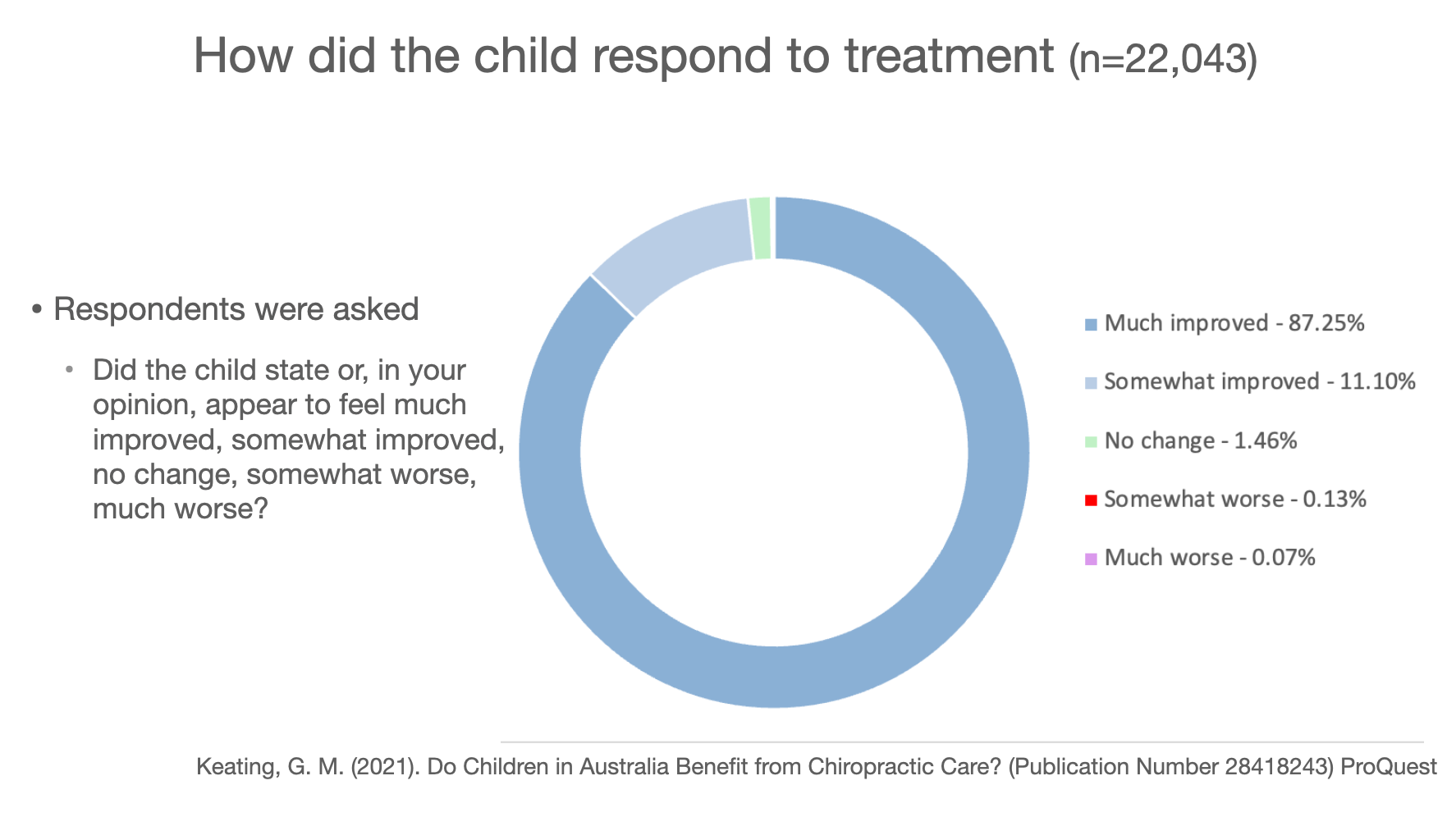
In 2019, the Victorian Government's Safer Care Victoria conducted a review of chiropractic care for children under 12, including a public consultation that drew 22,043 responses from parents who had accessed chiropractic care for their child. It was the largest public response the platform had ever received on any healthcare topic. Dr Genevieve Keating served on the review panel and, with permission, analysed the de-identified dataset for her doctoral research, which remains the largest known parental response survey on chiropractic care for children published to date.
Across this body of research, families reported:
- High rates of perceived benefit from the care their children received
- High satisfaction with the information they were given about both the benefits and the risks of care
- Strong satisfaction with the informed consent process and with being involved in decisions about their child's care
- Care that most often sat alongside, rather than replaced, input from GPs, maternal and child health nurses, and medical specialists, with most children concurrently under the care of other health professionals
The themes parents raised most consistently were the thoroughness of assessment, the gentleness of care, the time practitioners took to listen, and the value of feeling part of a collaborative team around their child.
Ready to book?
You can contact us on 03 9882 7012 or via our Contact page.
Dynamic Neurodevelopment is located at 1/650 Burwood Road, Hawthorn East. We welcome new patients of all ages.
Sources
Safer Care Victoria (2019). Chiropractic spinal manipulation of children under 12: Independent review. State of Victoria.
Keating, G. M. (2021). Parent reports of chiropractic care for children: A preliminary report from 22,043 parents in Australia. Journal of Clinical Chiropractic Pediatrics, 20(1), 1731–1732.
Keating, G. (2021). Parent reported experiences of chiropractic care for their children in Australia (Doctoral dissertation). Fielding Graduate University.
World Health Organization. WHO guidelines on basic training and safety in chiropractic
